Forging the Future: UNP Education and Telangana TPO Association Join Forces

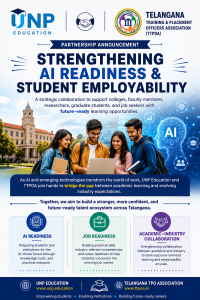
In a landmark move poised to reshape the landscape of graduate employment, UNP Education and the Telangana Training and Placement Officers Association (TTPOA) have officially initiated a strategic collaboration. This partnership is founded on a single, unwavering goal: ensuring the gainful employment and career success of the upcoming generation.

Addressing the Transitioning Employment Landscape

The global employment market is undergoing an unprecedented transition, driven primarily by the rapid advancement of Artificial Intelligence (AI) and other emerging technologies. Recognizing this shift, UNP Education and the Telangana TPO Association are pooling their expertise to equip students for the future proactively.

Our joint efforts will focus on empowering students not just to survive, but to excel in this new environment. The core strategy is simple yet powerful: we will ensure our students are proficient in emerging technologies and experts at using these innovations as powerful tools, thereby ensuring they become indispensable assets rather than redundant due to automation. This collaboration marks a decisive commitment to transforming potential challenge into palpable opportunity.

What the leaders said

The leadership of both organizations consists of highly experienced educators and industry veterans. They possess a deep understanding of the nation’s talent pool and are acutely aware of the industry’s evolving, specific talent requirements.

Dr. Jayram, President of Telangana TPO Association, said: “Partnering with UNP Education significantly strengthens our capability to address the AI revolution head-on, ensuring our talent pool is leaders and innovators in tomorrow’s technological landscape. Our focus remains the gainful employment of every student.”

Amarendra Vajjhala, CEO, UNP Education, highlighted: “This is a shared vision for the future. The swift evolution of AI demands a proactive approach to skilling, ensuring our students’ careers are resilient, rewarding, and future-proof.”

Sri Venkat Ramana Kuruhuri is an industry-academia expert with more than three decades of experience. He is constantly mentoring UNP Education because he shares the same vision. According to him: “Adaptability is the highest-value currency. Students must view emerging technologies as co-pilots, not competitors. This program embeds critical thinking and competence, enabling students to utilize these tools to amplify their own human ingenuity.”
 

Indispensable Capabilities for K12 School Students in the AI Era

The world is changing at breakneck speed, and Artificial Intelligence (AI) is leading the charge. 

Many educators are still contemplating whether we should allow school students to use AI. The rate at which AI penetrated the workforce and our daily lives means that avoiding AI is not an option. The question is no longer about “whether” it’s about “how” we get our school students ready in the AI era. 

We understand the dilemma, and our goal is to ensure the next generation possesses a strong foundation and robust logical skills. Instead of being disadvantaged by AI, we aim for students to be significantly enhanced by it. This is why our focus is firmly on the “how”.

For students in school today, the skills that guaranteed success yesterday are rapidly becoming automated. The question isn’t “What facts should I memorize?” but “What core abilities will make me indispensable?”

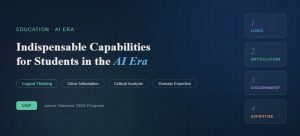
The answer lies in building four foundational capabilities that will remain valuable, no matter how technology evolves.

  1. Deep Logical Foundation and Algorithmic Thinking: Future success isn’t about knowing the answer; it’s about solving the problem. Students must develop the ability to break down any new challenge or circumstance into its fundamental components and devise a step-by-step solution. This is algorithmic thinking: the deep logical foundation that allows you to analyze, troubleshoot, and engineer solutions from the ground up, providing a critical edge over tools, even AI tools, that merely execute what we ask.
  1. The Art of Clearly Articulating the Requirement: With powerful AI tools at your fingertips, the most valuable skill is shifting from having the answer to asking the right question. AI is only as good as the input it receives. Students must master the art of defining problems clearly, framing requests precisely, and articulating requirements without ambiguity. This is the essence of effective communication and the emerging field of prompt engineering, a superpower in the AI era. Not only for AI, but good articulation is an invaluable skill in human interaction as well, which can make or break businesses and deals.

  1. Critically Analyzing the Output: AI is a fantastic partner, but it is not infallible. Its output is limited by its training data and can be flawed, biased, or simply incorrect (a phenomenon known as “hallucination”). The third essential capability is the skill of skepticism and critical analysis. Students must learn to evaluate, test, and verify any solution thrown at them, whether from a machine or a textbook. The ability to spot a bad result and understand why it’s bad will be priceless.
  1. Going Deep into the Functional Domain: As AI automates more general tasks, expertise in a specific area becomes exponentially more valuable. Deep domain knowledge is what informs the right questions to ask an AI and provides the necessary context to critically analyze its results. Whether it’s advanced biology, historical context, or complex financial systems, functional domain expertise transforms a general AI user into a specialized expert. This depth of knowledge will be the ultimate differentiator in the coming years.

The time to build these foundations is now.

The UNP Junior Summer 2026 program is specifically designed to orient students to this new way of thinking, focusing on developing these four capabilities for a future in which humans and AI work together.

WhatsApp Group