Unlock Your Data Science & ML Potential with Python

Join our hands-on courses and gain real-world skills with expert guidance. Get lifetime access, personalized support, and work on exciting projects.

Join Now Browse Course

Skills AI Can’t Replace

Skills AI Can't Replace
AI has shown significant potential in searching for and synthesizing accurate answers. Nevertheless, there are several essential skills that AI cannot replicate, which remain uniquely human. As human beings, we are the product of millions of years of evolution. Traits that have contributed to our survival over hundreds of thousands of years include our curiosity, our instinct to verify, accountability as a hallmark of leadership, and our emotional responses. AI is merely a piece of code, developed by humans and trained on data mostly generated in recent decades. Let’s explore the key skills that are truly human and that we need to sharpen more than ever before
Inquisitive nature
One critical area where AI falls short is in posing relevant questions. In our blog “The power of inquiry: why questions outshine answers in the age of AI”, we discussed why the future winners will be those asking the relevant questions rather than possessing the right answers.

AI can process information and provide answers, but it lacks the intuitive ability to identify the core issues and formulate insightful questions. This is a deeply human trait, rooted in curiosity and a desire for deeper understanding. Humans excel at recognizing context, identifying gaps in knowledge, and formulating questions that drive meaningful inquiry.

Responsibility

Furthermore, AI needs human support to ensure accuracy and address ethical concerns. While AI can generate responses quickly, it lacks the nuanced judgment to verify the correctness of its outputs in all cases. A second line of defence for verification is becoming more crucial. That includes verificatio of the source of the information, as well as setting up the right test cases in case of generating code using AI.

The ethical dimensions of AI responses also require human oversight. Humans provide a crucial layer of scrutiny, ensuring that AI outputs are accurate, fair, and aligned with ethical principles.

Accountablity

Ultimately, accountability for any delivery, such as products or reports, rests with humans. AI cannot be held accountable as there is no existing legal framework for it, nor is one possible. Individuals willing to accept responsibility will be respected and valued by society. Being accountable necessitates a thorough understanding of the related technical, social, and economic issues.

Emotion

Another vital aspect that remains uniquely human is the ability to understand and respond to emotions. AI is yet to learn the intricate nuances of human emotions. Humans possess emotional intelligence that allows them to connect with others on a deeper level, understand emotional cues, and provide empathy. We know the intended readers and can understand the emotional reactions based on reading the AI-generated articles, adjusting as needed. This emotional connection is indispensable in fields such as communication, where understanding and responding to emotions is paramount.

In conclusion, while AI brings powerful capabilities to the table, it is not a replacement for human intellect and emotional depth. The skills of asking relevant questions, ensuring accuracy and ethical considerations, and understanding emotions are the skills that will remain invaluable.

Unlock Your Data Science & ML Potential with Python

Join our hands-on courses and gain real-world skills with expert guidance. Get lifetime access, personalized support, and work on exciting projects.

Mastering Data science & Machine Learning

Unlock Your Data Science & ML Potential with Python

Join our hands-on courses and gain real-world skills with expert guidance. Get lifetime access, personalized support, and work on exciting projects.

Our Students Testimonials:

A Lesson from Charlie & The Chocolate Factory

A Lesson from Charlie & The Chocolate Factory

In a pivotal scene from Charlie and the Chocolate Factory, Charlie Bucket’s father, Mr. Bucket, experiences a heartbreaking layoff after a new machine replaces his job screwing toothpaste caps. This scenario reflects today’s workforce concerns about technological advancements. 

Ironically, he later finds a new job maintaining the machine that replaced him.  

This beautiful yet sobering story highlights a universal truth: technology has always transformed the job landscape, often taking away jobs but also creating new opportunities. 

From the spinning jenny of the Industrial Revolution to the automatons of today’s factories, the narrative of technology displacing workers is not a new one. Yet, as we stand on the cusp of unprecedented change driven by artificial intelligence (AI), the conversation has reached a critical juncture.  

AI is advancing at an astonishing pace, capable of executing tasks once thought to require human intelligence. From automating customer service inquiries to analyzing vast data sets for insights, AI is revolutionizing industries at a speed we have never witnessed before. According to various studies, millions of jobs could be lost in the coming years due to AI and automation, and it has already begun. 

However, this transformative technology also presents an extraordinary opportunity for us to adapt and evolve.  

In this whirlwind of change, upskilling is not just a necessity—it’s a lifeline. Upskilling refers to the process of learning new skills to remain competitive in the job market. As roles evolve and new technologies emerge, continuous learning becomes paramount for professional survival and growth. The urgency to upskill cannot be overstated.  

One of the remarkable aspects of the current situation is that we have AI tools at our disposal to facilitate learning, starting from creating a learning path, pointing us to the right content available online, and testing our new skills. Today, we can learn more effectively and with greater quality.

It’s essential to acknowledge that while AI may render some jobs obsolete, it also creates new opportunities that require a different skill set. Instead of fearing job loss, we must embrace the mindset of continuous improvement.

In conclusion, AI is rapidly transforming the job market, but individuals can take control of their futures through upskilling. Just like Mr. Bucket turned his job loss into an opportunity to work with the technology that replaced him, we too can thrive amidst change. 

At UNP, we encourage and teach all our students to leverage AI and available resources to enhance learning and turn challenges into advantages. 

The Power of Inquiry: Why Questions Outshine Answers in the Age of AI

The Power of Inquiry: Why Questions Outshine Answers in the Age of AI

In an era where Artificial Intelligence generates answers faster than we can ask questions, the most valuable skill is not having all the answers but asking the right questions. In a landscape transformed by AI, formulating insightful inquiries is crucial. 

Gone are the days when memorization was the pinnacle of achievement. AI can process vast data quickly but lacks the ability to understand context and nuance. Human intellect allows us to question, challenge, and explore the ‘why’ and ‘how.’

Asking the right questions fuels innovation, pushing boundaries and discovering solutions that AI can’t identify. While AI offers answers based on existing data, human curiosity reveals gaps and challenges assumptions, envisioning possibilities beyond the known.

The nature of our questions also shapes AI development. How we frame inquiries influences AI’s tasks, values, and integration into our lives. By asking thoughtful questions, we guide AI to solve real-world problems and create genuine value. 

In coding and software engineering, the focus is shifting from writing code to formulating the right requirements and questions. As AI generates code snippets, understanding the problem, asking clarifying questions, and articulating software needs become paramount. Defining the “what” and “why” sets engineers apart, allowing them to use AI effectively for complex problem-solving. Critical thinking, communication, and problem-solving are now more important than sheer technical skills.

In this era of AI, let’s not just seek answers; let’s master the art of asking insightful questions. Embrace curiosity, challenge assumptions, and drive innovation. The future belongs to those who know what to ask.

Asking difficult questions is encouraged in every UNP course, whether to professional instructors or generative AI tools like Gemini, ChatGPT, or Tabnine.

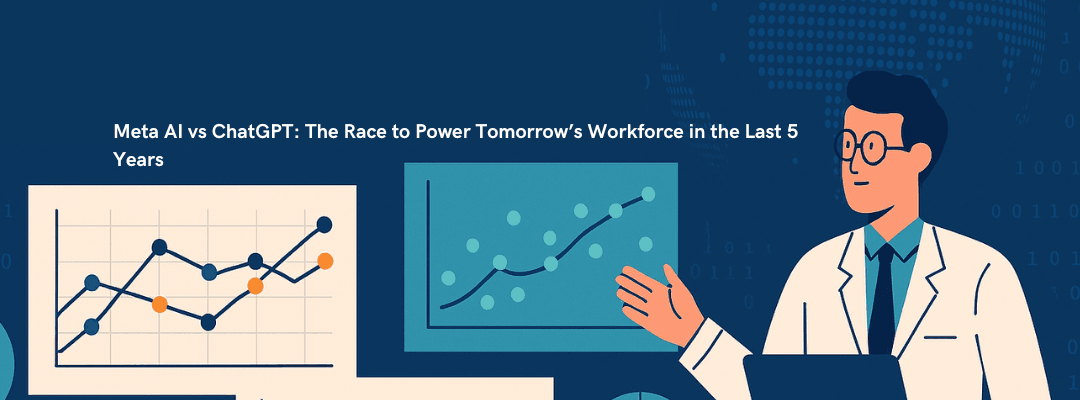
Meta AI vs ChatGPT: The Race to Power Tomorrow’s Workforce in the Last 5 Years

Meta AI vs ChatGPT: The Race to Power Tomorrow’s Workforce in the Last 5 Years

Between 2020 and 2025, the landscape of work has been transformed by two artificial intelligence giants: Meta AI and ChatGPT. Their rapid evolution and widespread adoption have not only automated routine tasks but also redefined job roles, productivity, and the very skills required to thrive in the modern workforce. This report examines how Meta AI and ChatGPT have competed and complemented each other in shaping the future of work, highlighting their unique strengths, industry impacts, and implications for employees and employers alike.

Meta AI: Infrastructure, Integration, and Enterprise Transformation

Meta AI, developed by Meta Platforms Inc., has focused on seamless integration within enterprise ecosystems and social platforms. Its strengths lie in:

Productivity Gains: Businesses that implemented Meta AI solutions reported productivity increases of up to 40%, with automation freeing employees from repetitive tasks and allowing them to focus on strategic, value-added work.

Workflow Automation: Meta AI’s natural language processing automates customer interaction analysis, streamlines internal communications, and accelerates data retrieval and decision-making.

Industry-Specific Tools: Meta AI’s computer vision and machine learning automate quality control in manufacturing, document verification in finance, and claims processing in healthcare.

Enhanced Security and Compliance: Robust security measures ensure sensitive data is protected, a critical factor for highly regulated sectors.

Real-Time Assistance: Integrated into platforms like Facebook, WhatsApp, and Instagram, Meta AI provides instant access to information, improving both customer engagement and internal collaboration.

By embedding AI into daily workflows, Meta AI has enabled enterprises to optimize processes, reduce operational costs, and respond to market changes with greater agility.

ChatGPT: Generative AI and Workforce Augmentation

ChatGPT, from OpenAI, has become synonymous with generative AI and conversational intelligence. Its influence on the workforce includes:

Automation of Knowledge Work: ChatGPT now handles up to 85% of enterprise customer service interactions, reducing costs and response times while freeing human agents for complex problem-solving.

Creation of New Roles: The rise of ChatGPT has led to new job categories such as AI trainers, data analysts, prompt engineers, and ethical AI specialists, reflecting a shift toward collaboration between humans and AI.

Upskilling and Continuous Learning: ChatGPT encourages a culture of ongoing learning, as users refine its responses and adapt its outputs to evolving business needs. This iterative feedback loop enhances both the model and user skills over time.

Breaking Down Barriers: Real-time translation and global collaboration features allow teams to work seamlessly across geographies, democratizing access to information and opportunity.

Driving Innovation: Professionals skilled in ChatGPT are in high demand, with roles commanding salaries up to 47% higher than traditional tech jobs. Companies across sectors seek talent that can leverage generative AI to drive efficiency and creativity.

ChatGPT’s rapid adoption has fundamentally changed how organizations approach automation, creativity, and talent development, making it a cornerstone of the modern digital workplace.

ChatGPT: Generative AI and Workforce Augmentation

ChatGPT, from OpenAI, has become synonymous with generative AI and conversational intelligence. Its influence on the workforce includes:

Automation of Knowledge Work: ChatGPT now handles up to 85% of enterprise customer service interactions, reducing costs and response times while freeing human agents for complex problem-solving.

Creation of New Roles: The rise of ChatGPT has led to new job categories such as AI trainers, data analysts, prompt engineers, and ethical AI specialists, reflecting a shift toward collaboration between humans and AI.

Upskilling and Continuous Learning: ChatGPT encourages a culture of ongoing learning, as users refine its responses and adapt its outputs to evolving business needs. This iterative feedback loop enhances both the model and user skills over time.

Breaking Down Barriers: Real-time translation and global collaboration features allow teams to work seamlessly across geographies, democratizing access to information and opportunity.

Driving Innovation: Professionals skilled in ChatGPT are in high demand, with roles commanding salaries up to 47% higher than traditional tech jobs. Companies across sectors seek talent that can leverage generative AI to drive efficiency and creativity.

ChatGPT’s rapid adoption has fundamentally changed how organizations approach automation, creativity, and talent development, making it a cornerstone of the modern digital workplace.

Comparative Impact: Meta AI vs ChatGPT

AspectMeta AIChatGPT
Core StrengthInfrastructure, platform integration, automationGenerative AI, conversational intelligence
Key IndustriesSocial media, analytics, healthcare, financeCustomer service, creative, education, legal
Innovation FocusCustom AI hardware, NLU, computer visionGenerative text, automation, creative content
Business ModelPlatform enhancement, enterprise AI toolsSaaS, API integration, workflow automation
Adoption SpeedGradual, infrastructure-drivenRapid, mass-market and cross-industry
Workforce ImpactProductivity, workflow optimization, data securityRole creation, upskilling, global collaboration

Real-World Examples

Expedia: Integrated ChatGPT to act as a travel assistant, streamlining planning and customer service.

Octopus Energy: Used ChatGPT to handle 44% of customer inquiries, improving satisfaction and reducing workload.

Manufacturing & Finance: Meta AI automates quality control and compliance, reducing errors and processing times.

Education: Both platforms power adaptive learning and AI-driven tutoring, making education more accessible and personalized


Workforce Transformation: Risks and Opportunities

Job Displacement vs. Creation: While AI has automated many repetitive tasks, it has also created new roles and increased demand for AI-literate professionals. The World Economic Forum projects a net gain of 78 million jobs globally by 2030 due to AI adoption.

Skill Shift: 39% of core skills are expected to shift by 2030, with AI and analytics leading the transformation.

Productivity and Profitability: Companies that fully integrate AI report significant gains in both productivity and profitability, with AI-driven innovation becoming a key differentiator.

Continuous Learning: The workforce now requires ongoing upskilling in AI, data analysis, and prompt engineering to remain competitive.

Conclusion

The race between Meta AI and ChatGPT has not only accelerated the adoption of artificial intelligence in the workplace but also redefined the very nature of work. Meta AI’s infrastructure-driven, enterprise-focused approach has optimized workflows and boosted productivity, while ChatGPT’s generative capabilities have democratized access to information, fostered innovation, and created new career opportunities. Together, they have powered a workforce that is more agile, creative, and prepared for the demands of tomorrow’s economy

From Chaos to Clarity: How Data Science Tamed the Information Explosion Over the Past 5 Years

From Chaos to Clarity: How Data Science Tamed the Information Explosion Over the Past 5 Years

Over the last five years, we have witnessed an unprecedented surge in data generation that has transformed how organizations operate and make decisions. This exponential growth in information—often called the “data explosion”—has created both immense challenges and remarkable opportunities. Data science has emerged as the critical discipline that converts overwhelming chaos into actionable insights, helping businesses and researchers navigate this vast ocean of information. This report examines how data science methodologies, tools, and applications have evolved to manage the exponential growth of data between 2020 and 2025, bringing structure and insight to what would otherwise remain an unmanageable deluge of information

The Scale of the Information Explosion

he data explosion phenomenon represents an extraordinary acceleration in the volume of digital information being generated worldwide. In 2020, approximately 32 zettabytes of data were produced globally, but forecasts indicate this will surge to an astounding 181 zettabytes by 2025. This five-fold increase within just five years illustrates the magnitude of the challenge facing organizations and individuals trying to extract meaningful insights from this information overload.

This explosive growth stems from multiple factors reshaping our digital landscape. The proliferation of Internet of Things (IoT) devices, expanding social media platforms, increased cloud computing adoption, and the growth of e-commerce have all contributed significantly to this data deluge. With more people and machines connecting to the internet each second, the rate of data generation continues to accelerate at an unprecedented pace.

The formal definition of “Data Explosion” describes it as “the rapid or exponential increase in the amount of data that is generated and stored in computing systems, which reaches a level where data management becomes difficult”. This difficulty manifests in traditional systems being unable to store and process all the data efficiently, creating complexity in handling and analyzing information appropriately.

For businesses, this flood of information creates significant challenges. A Gartner survey found that 38% of employees report receiving an “excessive” volume of communications, with only 13% saying they received less information than the previous year. This information overload has led to decision paralysis, inefficient resource allocation, and a general lack of clarity in business operations3.

The Evolution of Data Science Tools and Approaches

As data volumes have grown exponentially, the field of data science has undergone significant evolution to address these new challenges. The data science platform market reflects this growing importance, valued at $103.93 billion in 2023 and expected to reach $776.86 billion by 2032, representing a compound annual growth rate (CAGR) of 24.7%. Similarly, the data science and predictive analytics market is projected to grow from $16.05 billion in 2023 to $152.36 billion by 2036.

The maturation of the data science field is evident in how organizations approach data challenges. What was once an undersaturated field that someone could enter with minimal qualifications has transformed into a specialized profession requiring specific expertise. As one industry observer noted, “bootcamps, free courses, and ‘Hello World’ projects” no longer meet the demands of employers seeking professionals who can effectively manage and derive insight from massive data volumes.

This evolution has coincided with the development of more sophisticated tools and approaches. Machine learning algorithms have become the “quiet architects of clarity,” with the ability to “tame the chaos, find patterns in the noise, and guide us toward actionable knowledge”1. These algorithms possess the power to transform disorder into understanding, offering a clear path forward through the vast ocean of information1.

Machine Learning Algorithms Bringing Order to Chaos

K-Means Clustering has emerged as one of the fundamental techniques for bringing order to unlabeled data. This unsupervised learning approach partitions datasets into distinct clusters based on similarity, allowing organizations to identify natural groupings within their data without predefined categories1. Its applications have proven particularly valuable in customer segmentation, where businesses use it to classify customers based on purchasing behavior or preferences, enabling more targeted marketing strategies1.

Beyond traditional algorithms, the period has witnessed the rise of Automated Machine Learning (AutoML) and AI-powered analytics. These technologies have democratized access to sophisticated data analysis by automating complex aspects of model development and deployment. By 2025, AI-powered analytics has become widely adopted for predictive analytics, anomaly detection, and decision support, enhancing real-time analysis capabilities and enabling businesses to respond more quickly to changing conditions4.

The Rise of Edge Computing and Distributed Data Processing

Edge computing has emerged as another transformative approach during this period. Rather than processing all data in centralized cloud environments, edge computing brings data processing closer to the source, reducing latency and bandwidth usage. This approach proves particularly valuable for scenarios requiring real-time analysis.

In 2025, the integration of edge computing with data science has seen widespread adoption across multiple sectors. Industries like healthcare, manufacturing, and autonomous vehicles have benefited immensely from this trend, as it enables faster processing of time-sensitive data without the delays associated with transmitting information to distant data centers.

This shift toward distributed processing represents a fundamental change in how organizations manage the data explosion. Instead of attempting to funnel all information to centralized repositories—a strategy that becomes increasingly untenable as data volumes grow—edge computing allows for more efficient filtering and processing of information at its source, ensuring that only relevant insights travel through the network.

Real-World Applications and Impact

The practical applications of data science in managing information overload have spread across virtually every sector between 2020 and 2025. Through sophisticated algorithms and approaches, businesses predict future trends, researchers unlock medical breakthroughs, and scientists make groundbreaking discoveries1.

In the business world, data science tools help organizations cut through information “noise” to focus on what truly matters for productivity and innovation. Companies leverage these tools to extract meaningful insights from massive amounts of data, avoiding the decision paralysis and inefficient resource allocation that often result from information overload.

Self-service analytics platforms have become more intuitive and powerful during this period, with enhanced natural language querying, drag-and-drop interfaces, and AI-driven recommendations empowering more employees to leverage data without specialized technical knowledge. This democratization of analytics capabilities has accelerated the transition toward more data-driven organizational cultures, where decisions at all levels are informed by relevant insights rather than intuition alone.

The healthcare industry has seen particularly transformative applications, with data science helping to manage the enormous volumes of patient data, research findings, and treatment outcomes. Real-time analytics powered by edge computing enable faster and more accurate diagnoses, while predictive models help identify potential disease outbreaks or individual health risks earlier than previously possible.

Challenges and Limitations in Taming the Data Explosion

Despite significant advances in data science’s ability to manage the information explosion, several challenges remain persistent. One fundamental limitation is that technology alone cannot solve the problem of information overload. As noted by industry analysts, “it’s something where technology can’t just be tossed at this problem”. The human element remains crucial, with organizations needing to develop strategies that help employees process and prioritize information effectively.

Storage management presents another ongoing challenge. As data volumes continue to grow, organizations face increasing costs for storage infrastructure, whether on-premises or in the cloud. The “hidden challenges of data management” include not just direct costs like additional hard disks and electricity but also indirect costs related to managing databases, which are “usually much higher”.

The field also faces a growing skills gap. While data science jobs are projected to grow by 35% from 2022 to 2032 (compared to just 3% average growth for all jobs)5, finding professionals with the right mix of technical skills, domain knowledge, and practical experience remains difficult. The field’s maturation means employers have become more selective, looking for specialized expertise rather than general knowledge of data science concepts.

This evolution reflects a broader trend in the discipline: “The need for data science has not decreased or been replaced; instead, it’s the field of data science maturing, with a greater demand for specialized skills and practical experience”. Organizations increasingly recognize that effective data management requires more than basic analytical capabilities—it demands professionals who understand both technical methodologies and the specific business contexts in which they apply.

The Future of Data Management: Emerging Trends

Looking toward the future, several emerging trends appear poised to further transform how data science manages information overload. Quantum computing, while still limited in commercial applications, is beginning to influence data science research and applications. In 2025, advances in quantum algorithms are paving the way for groundbreaking innovations in data processing capabilities.

Data democratization efforts continue to evolve, with self-service analytics tools becoming more powerful and accessible. The goal remains making data available to non-technical users across organizations, empowering more employees to leverage data without specialized expertise. This trend aligns with the broader objective of creating more data-driven organizational cultures, where information serves as a foundation for decision-making at all levels.

Responsible AI practices are also gaining increasing attention, with organizations focusing on transparency, fairness, and explainability in their data science applications. This reflects growing awareness of the ethical dimensions of data usage and the potential for biased or harmful outcomes if these considerations are not properly addressed.

Conclusion

The period from 2020 to 2025 has witnessed both an unprecedented explosion in data generation and remarkable advances in the data science tools and methodologies used to manage this information deluge. From sophisticated clustering algorithms to AI-powered analytics and edge computing, data scientists have developed increasingly effective approaches for transforming chaos into clarity.

The evolution of data science from an emerging discipline to a mature field with specialized roles and expertise underscores its critical importance in our information-rich environment. As one industry observer noted, “there are still more openings in data science than there are applicants,” and reliable indicators suggest “the field is growing, not shrinking”.

Organizations that have successfully navigated the data explosion have typically embraced a multifaceted approach, combining technological solutions with strategic changes in how information is collected, processed, and utilized. They recognize that effective data management is not merely a technical challenge but a fundamental aspect of organizational strategy in the digital age.

As we move beyond 2025, the ongoing growth in data volumes seems inevitable, making the continued evolution of data science methodologies essential. The trends toward more automated, distributed, and democratized approaches to data analysis suggest promising directions for addressing future challenges. In this context, data science remains not just a valuable discipline but an essential capability for any organization seeking to thrive amid the continuing information explosion.

Our Students Testimonials:

Unlock Your Data Science & ML Potential with Python

Join our hands-on courses and gain real-world skills with expert guidance. Get lifetime access, personalized support, and work on exciting projects.

Mastering Data science & Machine Learning

Unlock Your Data Science & ML Potential with Python

Join our hands-on courses and gain real-world skills with expert guidance. Get lifetime access, personalized support, and work on exciting projects.

WhatsApp Group